
Bridges to Nowhere // A desperate call for greatness evoking surpassed concrete models.
‘Caracas is a city that dreamt the Modern Dream in the early 50s due to the pushing of oil exchanges. Numerous buildings, private and public, were erected and highways became a symbol of its modernization. From a rural economy to an oil based production scheme, Caracas sought to become a city of progress. Being a relatively young city, that had scarcely 4km wide in the 1800s to a 40km wide city now a days, its development has been drastic and its construction fast. In the early 20th century the image of european cities was intended to revive in certain parts of the city as the city center has an urban scale allure that resembles those cities in which dwelling, shops and job sources are all in one place, with 7 story buildings alternating the old colonial houses with streets and sidewalks proportional to a mild pedestrian transit. However, transit became the form of progress, following the modern precept, the car and motor vehicles have been narrowly tied to the anxiety of progress since.
The city is a valley surrounded by hills and mountains, being flat topography one of its true lacking, where the valley takes about 14 km x 4 km of the approximate 40km x 30km overall surface. All hills, south, east and west have been populated with automotive transportation concept in mind. Public Transportation has been a huge challenge for the public administration which has not yet been truly confronted, and it remains in hands of independent unions commonly improvised, un signaled and poorly coordinated amongst the different routes and types of services. So the car remains the preferred type of transportation and the city has to live with the scars that road planners have affront upon it.
While formerly urban development had a middle urban scale the city took a spin in its urban planning and the highways came to stay, and more, to rupture the city. Separating north and south forming a barrier between communities that once where neighbors or even splitting some in half, examples are San Agustín del norte and San Agustín del Sur, La California Norte, La California Sur (North and South boroughs). This central Highway is also an enormous exchange device, though it serves the whole country for its good distribution, Caracas sees heavy traffic jams every day through its very heart packed with heavy load trucks, and obviously, several transporting gasoline, cargoes and convoys. There is no other regional highway nor train circuit for the merchandise distribution. Caracas seems to control everything that has to do with other cities needs.
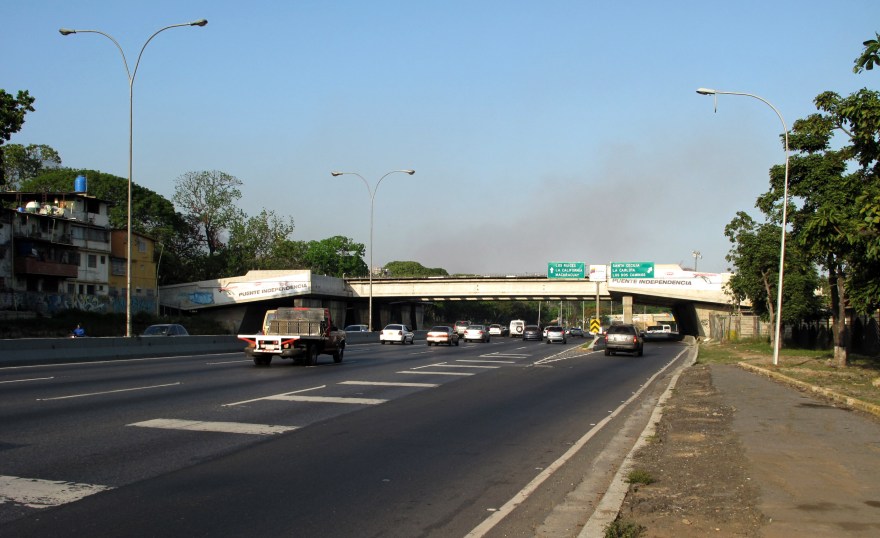
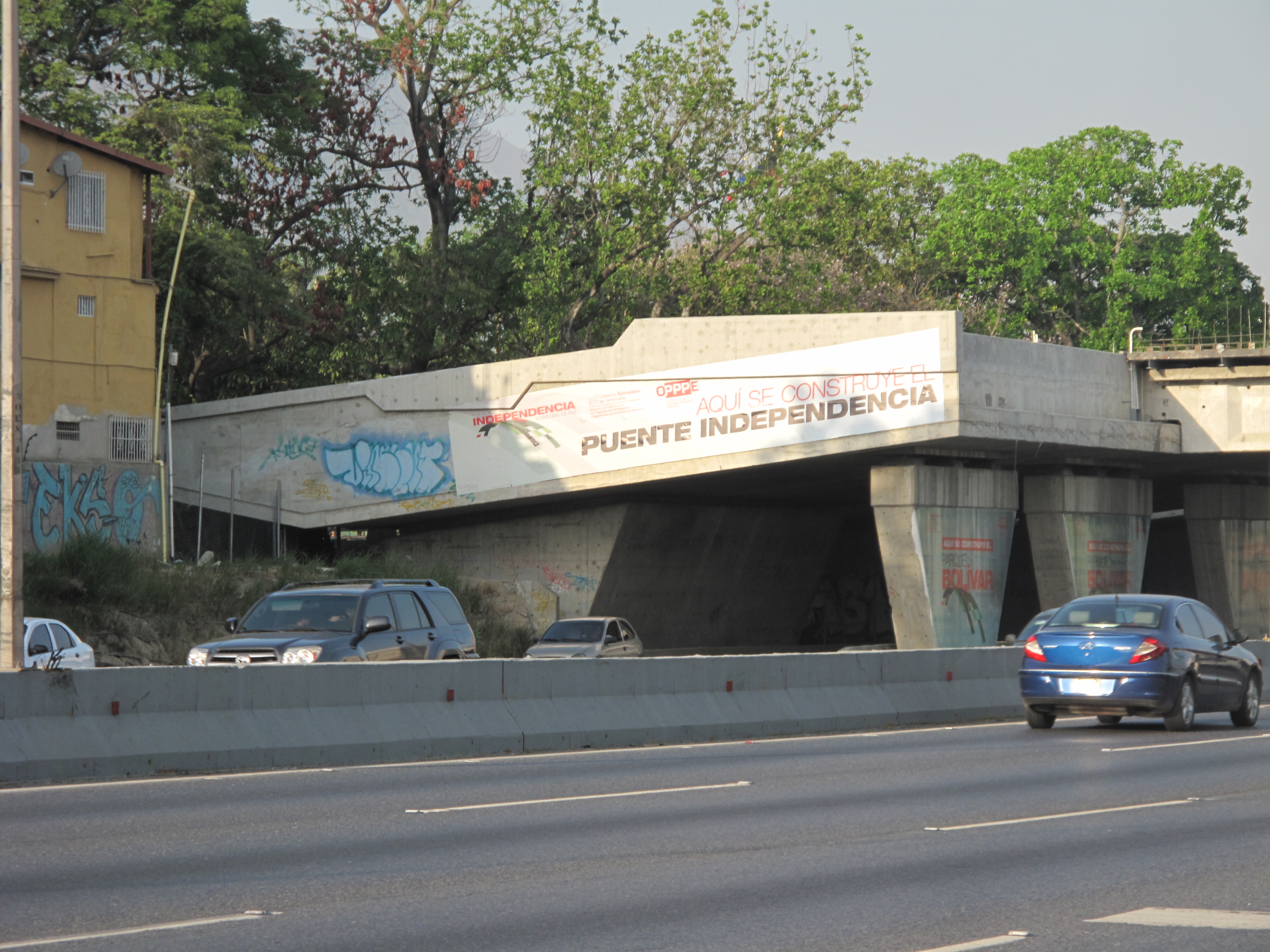
On the other hand, people and street for people seem overlooked, and even 30 years after the oil boom that generated such power illusion, massive roads are still in the urban and suburban consciousness. Many discussions have taken place in which solutions to the problem include schizophrenic disillusion such as adding a second story to the existing highway. It is noticeable that the idea of taking it out of the city never appears in politicians speeches. Furthermore, and this is where it gets tricky, the military airbase (Base aérea La Carlota – 103Ha , 254 acres) that lays in the middle of the valley was set for a metropolitan architectural debate in which it was designed to be a metropolitan park, merging itself with the existing patrimonial park Parque del Este (Parque Generalísimo Francisco de Miranda – 82 Ha, 202 acres), to expand to 185Ha – 457 acres- roughly of urban-metropolitan public space. Our concern, the highway, guess where it passes through… well yes, between this two portions of land. So the architectural competition stated also that a connection must be taken in account, and so it has. Its construction has begun, only not in a manner that could break or decrease the importance of concrete high speed layouts in the middle of the city but the exact opposite. This so called metropolitan bridge (Puente de la Independencia) presents once again an apology to private transportation. Solely by the symbolic image that it conveys, using bulky concrete structures that remember international airports surroundings. The design is merely engineered to bear its one weight and the language it uses takes great distance from an urban pedestrian based model, even if it is intended for public space, as if the bridge where to be crossed by a train that does not exist and not by people.
From the automotive perspective it conveys such an arid landscape to pass through this massive concrete site that confirms that Caracas will remain ruptured and scared, and those scares long from healing are being promoted with an industrial, progressive wannabe speech. From the inside of the existing park, that should be declared heritage due to its wonderful modern design by a team lead by Roberto Burle Marx and first opened in 1961, the arid sensation takes over also, when approaching to what will become this crossing platform. In addition to all the vexing mistreatment going on in the south side of the park, the north side is now facing demolition of its entrance, just to see a new one, poorly detailed and constructed, 20 meters away, apparently to enlarge the access doors of the original park that remain controlled even given the public nature of the site, this cannot be clarified given that government has a non disclosure policy around city planning and has not revealed what is intended for that area nor why demolition of the original entrance is necessary.
Ironically this so called Independence Bridge, states nothing but automotive dependence, and the failure to succeed at a human scaled city planning. Cars (not trains, metros, or even less actual humans) remain main objective of design even if regular wages won’t allow a regular person to buy one. Contradiction takes place all over the city when more people ask for public spaces, wider sidewalks, public efficient transportation means, decrease of commute times, a solution to persistent traffic jams. Well this city states out loud and in massive concrete those concerns are not in agenda today. We wonder if public management is in hand of people that doesn’t live in this city at all and thus ignore this, or a more serious problem lies within where this model has become the preferred image of progress all-about. While well-being and human scale have been displaced for good by bulky arid concrete structures that make space for the car.
Caracas, 20 July 2015 // Melicia Planchart //


 meliciaplanchart.com